

Commercial LED Grow Lights: 5 Smart Wins for Your Farm

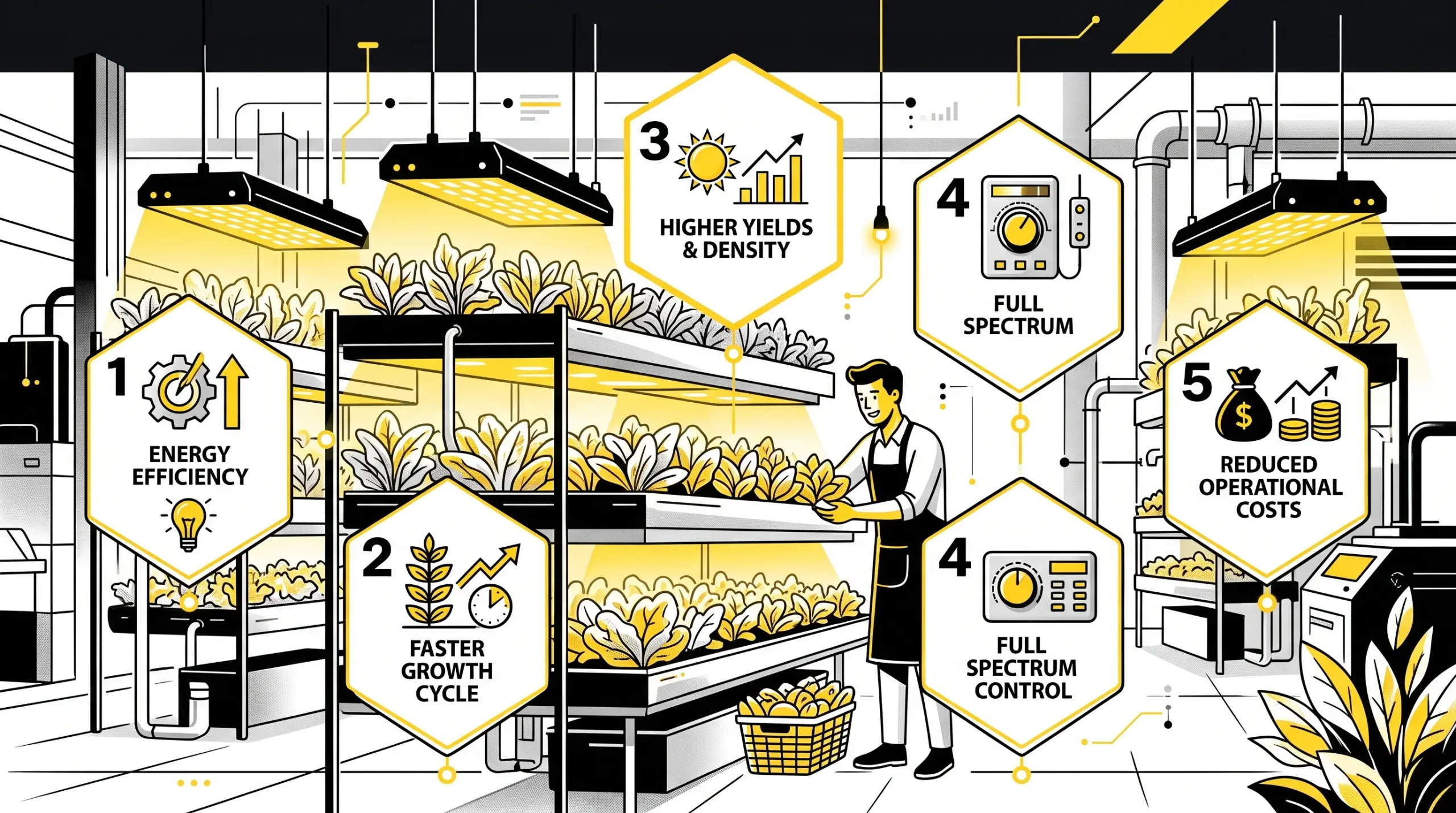
If you run a greenhouse or a vertical farm, your lighting decision affects your yield, your energy bill, and your bottom line every single day. Choosing the right commercial LED grow lights is not just about picking a fixture with a high wattage number. It is about matching light output, spectrum, and controls to your crop, your canopy height, and your growing method. This guide walks you through wattage, PPFD, spectrum, spacing, dimming, and cost savings so you can make a confident decision for your operation.
What Is PPFD and Why Does It Matter for Grow Lights?
PPFD stands for Photosynthetic Photon Flux Density. It measures how many photosynthetically active photons land on a square meter of your canopy every second, expressed as micromoles per square meter per second (umol/m2/s). This number matters more than raw wattage because two fixtures with the same wattage can deliver very different amounts of usable light to your plants depending on their optics, chip efficiency, and mounting height.
When you shop for commercial LED grow lights, ask for a PPFD map or a photometric file, not just a wattage spec sheet. A fixture rated for high output but installed too high above the canopy will underdeliver, while one mounted too close can create hot spots or photobleaching on the top leaves. Your target PPFD should shift with your growth stage:
- Seedlings and clones generally need lower PPFD, in the range most growers keep under 300 umol/m2/s
- Vegetative growth typically runs in the moderate range
- Flowering and fruiting crops usually call for the highest PPFD your crop tolerates
Daily Light Integral, which adds up PPFD over your full photoperiod, is the number that ultimately drives growth, so PPFD and your lighting schedule always work together.
Full Spectrum vs Red or Blue Grow Lights, Which Is Better for Commercial Crops?
This is one of the most common questions commercial growers ask before buying LED grow lights for vertical farming or greenhouse supplementation. Narrow red and blue spectrum fixtures were popular because red and blue wavelengths sit close to the peak absorption points of chlorophyll, which made them efficient for basic photosynthesis. However, plants also use green, far red, and other wavelengths for canopy penetration, stem structure, flowering response, and overall plant health.
Here is why full spectrum tends to be the better commercial choice:
- It supports a wider range of crops under one fixture, from leafy greens to flowering plants
- It reduces the visual stress of working under a purple grow room for staff
- It mimics natural daylight more closely, which supports more consistent plant morphology
- It gives you flexibility if you rotate crops or expand your product line later
The NEXGEN LED Grow Light fixtures are built around a full spectrum output, so you are not locked into a single crop type. If your operation grows a mix of herbs, leafy greens, and fruiting crops, full spectrum fixtures give you one lighting standard across your whole facility instead of swapping fixtures for every crop change.
What Wattage and PPFD Do Commercial LED Grow Lights Need for Greenhouse vs Vertical Farm Setups?
This is the core decision point, and the answer depends on whether you are supplementing sunlight or replacing it entirely.
Greenhouse operations use natural sunlight as their primary light source, so your fixtures are there to fill gaps during cloudy days, short winter daylight hours, or shoulder seasons. Because sunlight already provides a strong baseline, greenhouse growers often choose lower- to mid-wattage fixtures spread across the canopy to top up PPFD rather than carry the full photosynthetic load.
Vertical farm operations have no natural sunlight reaching most grow levels, so the fixture is the sole source of light for the entire crop cycle. This is called sole source lighting, and it demands higher and more consistent PPFD across every layer of the rack, along with tighter mounting distances since vertical farms usually run shallow canopy-to-fixture gaps.
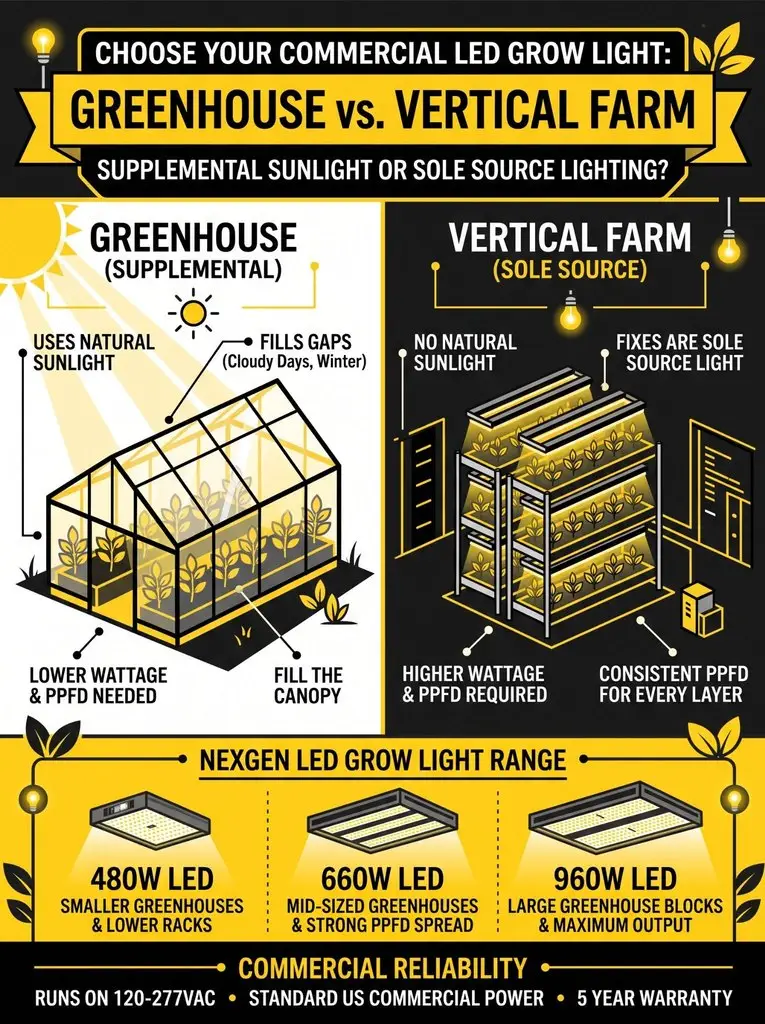
This is where matching your fixture wattage to your setup matters:
- A 480W LED Grow Light suits smaller greenhouse bays, supplemental zones, or lower tiers in a vertical rack where mounting height is limited
- A 660W LED Grow Light fits mid-sized greenhouse ranges or vertical farm racks that need a stronger, more even PPFD spread across a wider canopy.
- A 960W LED Grow Light is built for large greenhouse blocks or high-density vertical farm rows where you need maximum output per fixture to cover more canopy area with fewer total units.
All three units in the NEXGEN LED Grow Light range run on 120-277VAC at 50/60Hz, which means they work across standard commercial electrical infrastructure in the United States without needing a dedicated transformer, and each comes with a 5 year warranty for long term commercial reliability.
How Many LED Grow Lights per Square Foot for a Greenhouse?
There is no single fixed number here because fixture spacing depends on wattage, beam angle, mounting height, and your target PPFD. That said, commercial growers generally work through this process:
- Start with your target PPFD for the crop and growth stage
- Check the fixture manufacturer’s photometric data for coverage area at your intended mounting height
- Overlap coverage zones slightly at the edges to avoid dark gaps between fixtures
- Recalculate spacing whenever you change mounting height, since PPFD drops off quickly as distance from the canopy increases
Higher wattage fixtures like the 960W LED Grow Light typically cover more square footage per unit, which can reduce your total fixture count and simplify wiring runs across large greenhouse bays. Lower wattage units like the 480W LED Grow Light are often better suited to tighter spacing in propagation areas or narrow vertical farm shelving. Working with a wholesale LED grow lights supplier on a lighting layout plan before you order helps you avoid under-lighting or overspending on fixtures you do not need.
Do LED Grow Lights Need 0-10V Dimming for Controller Integration?
If your facility uses a central environmental control system, integration matters as much as raw output. Many commercial growers standardize on 0-10V dimming because it is a widely supported protocol across horticultural lighting controllers, allowing you to:
- Adjust PPFD by growth stage without physically moving fixtures
- Ramp lighting up and down gradually to reduce stress on plants and on your electrical system
- Sync your lighting schedule with your climate control, CO2 dosing, and irrigation systems from one interface
- Run energy management strategies during peak utility rate periods
Before you finalize your order, confirm the dimming protocol supported by your chosen fixture and make sure it matches your existing or planned control system so your commercial LED grow lights function as part of one connected facility rather than a standalone light source.
How Much Do Commercial LED Grow Lights Save vs HPS Lighting?
High-pressure sodium fixtures were the commercial standard for years, but LED has become the preferred choice for new builds and retrofits for a few clear reasons:
- LED fixtures convert a higher share of electrical input into usable light rather than heat, which lowers your electricity draw for the same light output
- Lower heat output reduces the load on your cooling and ventilation systems, which is a real operating cost in enclosed vertical farms.
- LED fixtures generally last far longer than HPS bulbs, cutting your replacement labor and lamp replacement costs over the life of the system
- Full spectrum LED options reduce the need for separate fixtures across different growth stages
For growers comparing full spectrum grow lights for greenhouse retrofits against their existing HPS setup, the combined savings on electricity, cooling load, and maintenance are usually the deciding factor, especially across a multi-year commercial operating budget.
Conclusion
Picking the right lighting setup comes down to matching your fixture wattage and PPFD output to your crop, your growing method, and your facility electrical standard. Whether you are supplementing sunlight in a greenhouse or running a fully enclosed vertical farm, the NEXGEN LED Grow Light lineup, including the 480W, 660W, and 960W models, gives you a full spectrum option built for 120-277VAC commercial power with a 5 year warranty behind it. Reach out to the NEXGEN LED team today for a lighting layout recommendation tailored to your square footage and crop plan.
FAQs
Can I mix different wattage grow lights in the same greenhouse zone?
Yes, many growers mix wattages between propagation areas and flowering rows, but keep each zone on its own PPFD target so plants at the same growth stage receive even light levels.
How long do commercial LED grow light fixtures typically last?
Most quality LED grow fixtures are rated for tens of thousands of operating hours, which is why manufacturer warranties, such as the 5 year coverage on NEXGEN LED Grow Light units, are a useful benchmark when comparing brands.
Does humidity in a greenhouse affect LED grow light performance?
Fixture housing and driver sealing matter more than the LED chips themselves in humid environments, so check the ingress protection rating before installing in high-humidity greenhouse zones.
Should vertical farms use the same PPFD target on every rack level?
Not always. Lower racks sometimes need slightly different PPFD or spacing due to airflow differences, so it helps to measure light levels rack by rack rather than assuming uniform output.
What electrical planning should I do before a wholesale grow light order?
Confirm your facility voltage, circuit capacity, and dimming protocol first, since fixtures built for 120-277VAC input like the NEXGEN LED Grow Light range can simplify wiring across mixed commercial power setups.